
Showing posts with label ichnography. Show all posts
Showing posts with label ichnography. Show all posts
Tuesday, 24 December 2019

Wednesday, 13 September 2017
stone stackers
“This movement of stones, whilst it may seem benign, is eroding the
nationally protected archaeological features of the site as well as its
local distinctiveness. We would encourage visitors to take only
photographs of, and to leave only footprints at, this very precious and
unique site.”


Sunday, 6 December 2015
Ground truth image sets
Ground truth image sets, including calibration images, are useful for
validation of software - testing the overall ability of the software to
provide realistic results with real images, under real-life conditions.
Ground truth images can also be modified and used to create
quasi-synthetic images for testing susceptibility of algorithms to
things like motion blur, image defocus, misregistration and noise.
The synthetic generation of samples make possible experiments with thousand of subjects (same benchmark data for all researchers) without any legal concern (avoiding also the time consuming acquisition procedures). You can find biometric synthetic generation for several traits: fingerprint, face, handwritting signature, iris, palm
The Sculptures 6k Dataset consists of 6340 images images collected from Flickr by searching for sculptures by Henry Moore and Auguste Rodin. The dataset is split equally into a train and test set, each containing 3170 images. For each set 10 different Henry Moore sculptures are chosen as query objects, and for each of these objects 7 images and query regions are defined, thus providing 70 queries for performance evaluation purposes.
The scripted (and unscripted) activities include: walk, browse, slump, left object, meet, fight, window shop, shop enter, shop exit.
Annotated biological image sets for testing and validation
The synthetic generation of samples make possible experiments with thousand of subjects (same benchmark data for all researchers) without any legal concern (avoiding also the time consuming acquisition procedures). You can find biometric synthetic generation for several traits: fingerprint, face, handwritting signature, iris, palm
The Sculptures 6k Dataset consists of 6340 images images collected from Flickr by searching for sculptures by Henry Moore and Auguste Rodin. The dataset is split equally into a train and test set, each containing 3170 images. For each set 10 different Henry Moore sculptures are chosen as query objects, and for each of these objects 7 images and query regions are defined, thus providing 70 queries for performance evaluation purposes.
The scripted (and unscripted) activities include: walk, browse, slump, left object, meet, fight, window shop, shop enter, shop exit.
Annotated biological image sets for testing and validation
Friday, 2 August 2013
Here in this terminal hut,
he began to piece together some sort of existence. Inside the hut he found a set of psychological tests, out of curiosity he ran them on himself. Although he had no means of checking them, his answers seemed to establish an identity. He went on to forage, and came back to the hut with some documents and a coke bottle.

At times when Xero approached the forlorn group sitting on the embankment, his shadows formed bizarre patterns on the concrete, transcripts of cryptic formulae and insoluble dreams. These ideograms, like the heiroglyphs of a race of blind seers, remained on the grey concrete after Xero had gone, the detritus of this terrifying psychic totem.

To begin with she wants to spend all her time writing poems on the damaged typewriter. Later, when not writing the poems, she wanders away to an old solar energy device and loses herself in the maze of mirrors.

All sorts of rubbish is lying in the sand: a typewriter with half the keys missing (he picks out fragmentary sentences, sometimes these seem to mean something), a smashed neurosurgical unit (he pockets a handful of leucotomes, useful for self-defence). Then he cuts his foot on the coke bottle, and spends several feverish days in the hut. Luckily he finds a drill for trainee astronauts, half of an 80 hour sequence.

At times when Xero approached the forlorn group sitting on the embankment, his shadows formed bizarre patterns on the concrete, transcripts of cryptic formulae and insoluble dreams. These ideograms, like the heiroglyphs of a race of blind seers, remained on the grey concrete after Xero had gone, the detritus of this terrifying psychic totem.

To begin with she wants to spend all her time writing poems on the damaged typewriter. Later, when not writing the poems, she wanders away to an old solar energy device and loses herself in the maze of mirrors.

All sorts of rubbish is lying in the sand: a typewriter with half the keys missing (he picks out fragmentary sentences, sometimes these seem to mean something), a smashed neurosurgical unit (he pockets a handful of leucotomes, useful for self-defence). Then he cuts his foot on the coke bottle, and spends several feverish days in the hut. Luckily he finds a drill for trainee astronauts, half of an 80 hour sequence.
Wednesday, 26 September 2012
Early Neurological Tools

Gilles de la Tourette and Footprint Diagrams
A. French neurologist George Gilles de la Tourette (1857-1904).
B. Footprint diagrams from the doctoral thesis of Gilles de la Tourette (1885) entitled Etudes Cliniques et Physiologiques sur la Marche. This student work analyzed normal gait as well as the walking patterns of patients with Parkinson’s disease, locomotor ataxia, Friedreich’s ataxia and numerous neuropathies.
Agamben - Notes on Gesture
Friday, 22 June 2012


The oldest known depiction of Stonehenge


1440? Corpus Christi College MS 194, fol 57


Folio 30r of British Library, Egerton 3028, a manuscript of English chronicles including an abreviated version the Brut by Wace. This illustration shows the construction of Stonehenge with the assistance of Merlin and is the oldest known illustration of Stonehenge. 1338 -40
British Archaeology
The foundation myth appears in the 12th century. Stonehenge, or Stanenges, is first briefly mentioned c1130 in Historia Anglorum, written by the archdeacon of Lincoln, Henry of Huntingdon, at the command of his bishop Alexander of Blois. "Noone can work out", says Henry, "how the stones were so skilfully lifted up to such a height or why they were erected".
Shortly after, around 1136, Geoffrey of Monmouth wrote his Historia Regum Britanniae, drawing on a vast range of material, from the Venerable Bede to British and continental legends, to build a history of the British kings from the Trojan Brutus up to the 7th century. The immense success of his much copied text shows the deep interest it rapidly inspired.
The passage concerning Stonehenge has often been described, and is well elaborated in Chippindale's Stonehenge Complete (Thames & Hudson, 3rd ed 2004). The legitimate British king, Aurelius Ambrosius, is in exile in Brittany while his usurper Vortigern allies himself with the invading Saxon king Hengist. Vortigern and Hengist arrange a peace meeting at the "cloister of Ambrius" (Amesbury), but the Saxons treacherously slay 460 British lords. Aurelius returns, defeats both Vortigern and Hengist, and seeks a memorial to the dead. Merlin recommends the chorea gigantum, a stone monument on the Irish Mount Killaraus. Only his magic, however, can bring the stones to Amesbury, and he reconstructs them exactly as they were in Ireland. The text shows Aurelius's coronation in c480 and the erection of Stonehenge c485. Later Aurelius and his brother Uther Pendragon (father of Arthur) are buried at Stonehenge.

Historians have spent years debating whether Stonehenge was once a complete circle. Despite numerous tests and excavations, the mystery remained unsolved for almost 5,000 years. But staff at the neolithic site believe the question has finally been answered - all because a hosepipe was too short.


Barack Obama in Stonehenge visit on return from Nato summitThe White House said the presidential helicopter Marine One stopped at Boscombe Down Airbase, Wiltshire, before his motorcade drove to the ancient monument.
Mr Obama described seeing the monument as "cool" and said it was something he could tick off his "bucket list".
10 September 2014 Last updated at 01:40
Archaeologists have unveiled the most detailed map ever produced of the earth beneath Stonehenge and its surrounds. They combined different instruments to scan the area to a depth of three metres, with unprecedented resolution. Early results suggest that the iconic monument did not stand alone, but was accompanied by 17 neighbouring shrines. Future, detailed analysis of this vast collection of data will produce a brand new account of how Stonehenge's landscape evolved over time.


Buzz Aldrin, the second man on the moon, has a message to Earth: it's
time to go to Mars. He's been broadcasting it loud and clear for years,
but now has made his mission even more majestic by posting this picture
of himself taken at Stonehenge.

| Plaatje van Stonehenge (GMG 432 88) | ||||
| Date | vanaf 1645 | |||
| Source | Biblioteca Nacional Espana | |||
| Author | Blaeu,J |
We promptly sat down with our backs to the sight we had come to see,
& began to eat sandwiches: half an hour afterwards we were ready to
make our inspection.


Tuesday, 1 May 2012

Monday, 5 September 2011

Thursday, 19 May 2011

a reading of the configuration of surfaces
To take the auguries is to believe in a world without man; to inaugurate means to give homage to the real as such.
Serres/ Rome / 12


Monday, 16 May 2011
both sides

Footprint on the Moon
July 1969, Armstrong and Aldrin step out of the lunar capsule and onto the surface of the Moon. Their landing place is the Sea of Tranquility. Aldrin describes the landscape as ‘magnificent desolation’. It is an immaculate surface: trackless, uninterpreted.
In slow motion their feet sink into a shallow layer of dust, compressing the dry particles to leave an impression. The moment has gravity. This fine dust has no relation to the moon rock below, it has been deposited by the impacts of asteroids and meteors. It is the debris of shooting stars, the fall-out of portents and warning signs. It presents a perfect recording surface. The ground of an image.
There is no wind or rain on the moon, no tide or breath to take this fragile footprint away. We cannot cover our tracks. We measure our months by the moon but this small step onto its surface leaves a mark in the vastness of cosmological time. The imprint endures as cities fall and continents shift. It will remain longer than the cave paintings, those ochre handprints which mark out the earliest trace of what it is to be human. Imprints are potent. Remember Robinson Crusoe’s shock at finding a footprint in the sand of his desert island. He is thunderstruck, fearful, as if he had seen an apparition. The affect of presence from these traces of absence is profound. We are haunted.
Buzz Aldrin photographs the imprint of his boot on the lunar surface with a 70mm Hasselblad camera. The image of the footprint is transferred to film by the action of light onto a sensitive surface; a trace of a trace. Image of an index. The photographic image is evidence to be measured, scrutinised, magnified: a scientific souvenir and a political emblem. This extraterrestrial image is proof of landfall.
Ted Kaczynski, the Unabomber, fabricated a pair of shoes with the soles of smaller sneakers attached. His purpose was to leave a false trail. It is an echo of the confusion Hercules felt on seeing the track of his stolen oxen leading in one direction but hearing their bellows from another. The thief had forced the animals backwards.
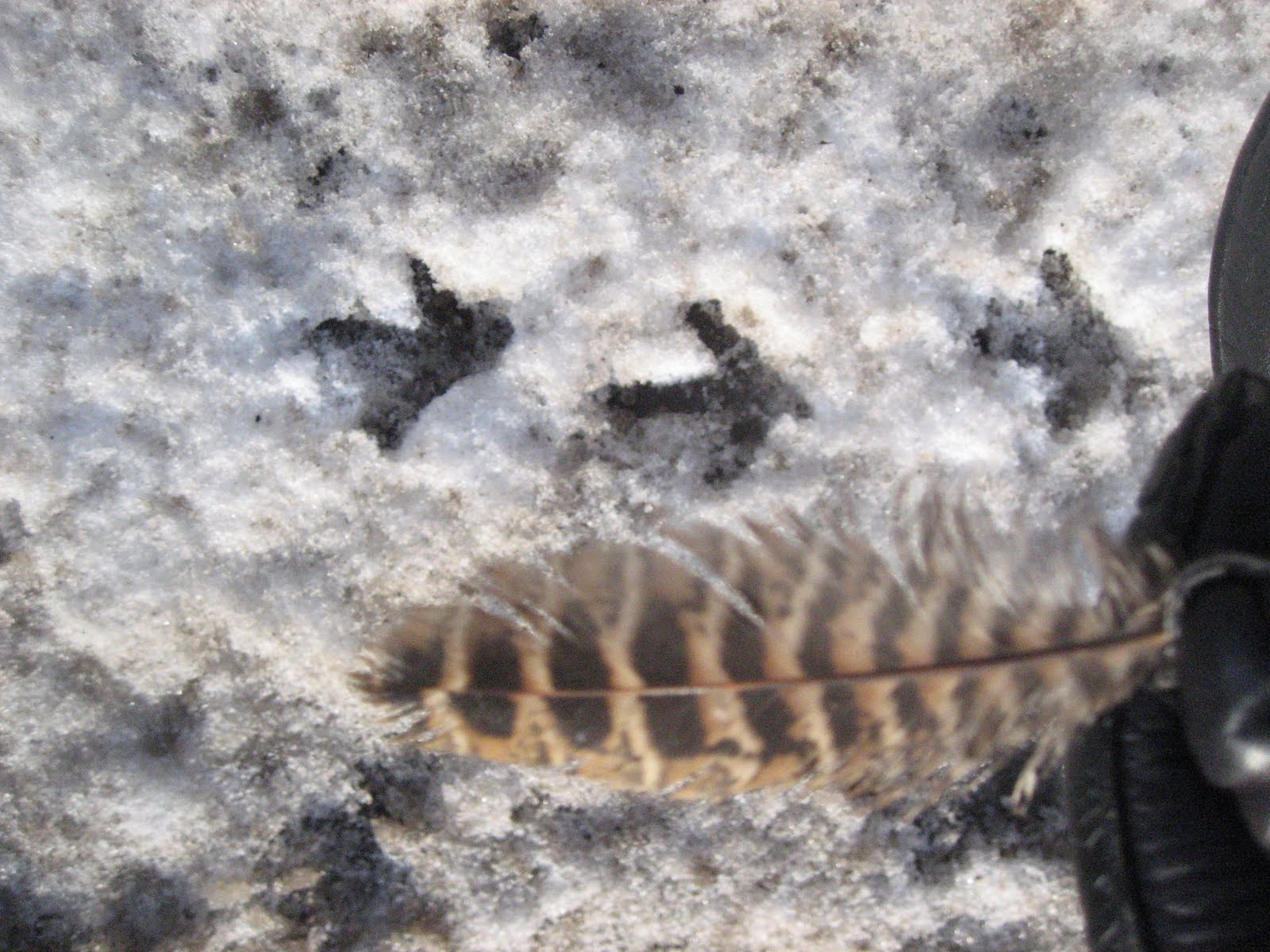
In December I saw the trail of a rabbit in the deep snow. The spoor ended abruptly in the middle of the field. Around the final footprints the traces of two broad wings were beaten into the snow, the feather tips distinct. Rabbit and buzzard assembled into a simple endgame or a composite beast?
Back down to Earth, Aldrin’s film is stored in a freezer. Later it is digitsed. The scan is an ambivalent form, reading an image as object, shifting categories back and forth. Information is packed into file formats. Image becomes code. In the form of zeros and ones the print propagates easily; accelerating into the space of exchange; our virtual common ground. There it multiplies, transforms, leaks information, becomes noise, returns to stardust.


Thursday, 14 April 2011

Friday, 14 January 2011
Fixed Point Theorem

If one stirs to dissolve a lump of sugar, it appears there is always a point without motion. He drew the conclusion that at any moment, there is a point on the surface that is not moving. The fixed point is not necessarily the point that seems to be motionless, since the centre of the turbulence moves a little bit. The result is not intuitive, since the original fixed point may become mobile when another fixed point appears.
Brouwer is said to have added: "I can formulate this splendid result different, I take a horizontal sheet, and another identical one which I crumple, flatten and place on the other. Then a point of the crumpled sheet is in the same place as on the other sheet." Brouwer "flattens" his sheet as with a flat iron, without removing the folds and wrinkles. wikipedia
The most important fixed point theorem is Brouwer's (deals with functions); the extention of this theorem to correspondences is given by Kakutani's fixed point theorem.
Tuesday, 4 January 2011

Friday, 24 December 2010

Thursday, 30 September 2010


Saturday, 10 July 2010


Sunday, 30 May 2010


Subscribe to:
Posts (Atom)


 Posts
Posts

