Showing posts with label robert peake. Show all posts

Monday, 12 August 2013

APelles painted a Mare and a Dogge so liuelie


APelles painted a Mare and a Dogge so liuelie, that Horses and Dogges pas|sing by woulde neigh, and barke at them; hee grewe so famous for his excellent Art, that great Alexander came often to his shoppe to visite him, and commaunded that none other should paint him; at his death hee left Venus vnfinished, neither was anie euer founde, that durst perfect, what hee had begunne. Zeuxis was so excellent in painting, that it was easier for anie man to view his pictures, then to imitate them, who to make an excel|lent Table, had fiue Agrigentine Vir|gins naked by him; hee painted Grapes so liuelie, that Birdes did flie to eate them. Parrhasius painted a Sheete so artificiallie, that Zeuxis tooke it for a Sheete in deede, and commaunded it to bee taken away to see the picture, that hee thought it had vayled; as learned and skilfull Greece had these excellent|ly renowned for their limning: so Eng|lande hath these; Hiliard,  Isaac Oliuer, and Iohn de Creetes, very famous for their painting.


As Greece moreouer had these Pain|ters; Timantes, Phidias, Polignotus, Pa|neus, Bularchus, Eumarus, Cimon Cleonaeus, Pythis, Apollodorus Atheniensis, Aristi|des The banus Nicophanes, Perseus, An|tiphilus, and Nicearchus: so in Englande wee haue also these; William and Francis Segar brethren, Thomas and Iohn Bettes, Lockey, Lyne, Peake, Peter Cole, Arnolde, Marcus, Iaques de Bray, Cornelius, Peter Golchis, Hieronimo and Peter Vande Uelde. As Lysippus, Praxiteles, and Pyrgoteles, were excellent engrauers: so wee haue these engrauers, Rogers, Christoper Swit|ser, and Cure.


Meres, Francis, 1565-1647.
Title: Palladis tamia Wits treasury being the second part of Wits common wealth. By Francis Meres Maister of Artes of both vniuersities.
Date: 1598 

Saturday, 10 August 2013

a broadside panegyric


Peake, Robert (active 1635-died 1667) Robert (later Sir Robert) Peake was son of the print publisher William Peake. In 1635 he and William jointly published The Booke of five Columnes at their house near Holborn Conduit. On William's death in 1639 (Edmonds, Burlington Magazine, 118 (1976), p. 79), Robert inherited and continued the business. He published the finest prints of the early 1640s: sixteen early Faithorne plates, as well as one by Glover (Hind III 233.22), Edward Pierce's set of friezes of 1640, Hollar's set of three-quarter-length Seasons of 1641 (Pennington 610-3), and several portraits of personalities in the Civil War, many as small ovals that were probably used as badges of allegiance. In a letter to Pepys of 26 September 1690, Evelyn stated that the man 'who had the most choice' of prints was Mr Peake of Holborn Conduit (H.C. Levis, Extracts from the Diaries and Correspondence of J. Evelyn and S. Pepys relating to Engraving (1915), p. 84). Peake was associated with Archbishop Laud in the production of a set of small plates designed to illustrate Bibles (see G.Henderson, 'Bible illustration in the age of Laud', Transactions of the Cambridge Bibliographical Society, 8 (1982), pp. 178ff.). In 1642 Peake closed his business in order to join the Royalist army. He arrived at Basing House as Lieutenant-Colonel on 31 July 1643 with William Faithorne serving as his ensign. As a soldier Robert had a glittering career, which culminated in his being knighted by Charles I at Oxford on 27 March 1645 (Vertue I p. 71 from Symonds ms). In October he was taken prisoner at the siege of Basing House, and a box of unspecified copper plates was found among his possessions. He was first imprisoned at Winchester House, then in Aldersgate, and was later exiled for refusing to take the oath of allegiance to Cromwell. He returned to England at an unknown time, and became vice-president and leader of the Honourable Artillery Company. He died in 1667, and was buried in St Sepulchre's. His will (Edmonds p. 133) shows that he had wished to spend the vast sum of £500 on his funeral, but that the Great Fire had consumed his 'houses and tenements at Holborn Conduitt' so that he had to reduce the sum to £200. His fame was such that a broadside panegyric was published on his death (BL 82 l.8(27)).

Peake, William (fl. 1626-died 1639) All previous writings on the Peake family have been made obsolete by Mary Edmond, who has worked out the family tree ('Limners and Picturemakers', Walpole Society, 47 (1978-80), pp. 129-33). She shows that there were three generations of the family in the publishing business. The eldest was the well-known painter Robert Peake (c.1551-1619), who held the position of Serjeant-Painter to James I jointly with John de Critz, and was also painter to Prince Henry. It was he who leased a house at Holborn Conduit from the Saddlers' Company, whence he published a number of books, such as the 1611 translation of Serlio's First Book of Architecture, which he dedicated to Prince Henry (Harris cat.817). The blocks used to illustrate this were imported from the Continent where they had first been used in Antwerp c.1540. William was his eldest son, and was also trained as a painter. Like all generations of the family he was a freeman of the Goldsmiths' Company. On his father's death in 1619 he inherited the shop at Holborn Conduit next to the Sun Tavern at the bottom of Snow Hill. Although he presumably took over his father's illustrated book publishing business, there are no signs of his acting as a publisher of single sheet prints before 1626. His address appears on a large number of ex-Humble plates. One of them (Hind II 265.45) has a date 1626 which suggests that the transfer took place in this year. In 1635 the engraver William Faithorne was apprenticed to him, and at an unknown earlier date the painter William Dobson. William published various sets of Senses, Complexions, Worthies etc. by Cecill and Glover.

http://www.bpi1700.org.uk/resources/directory_publishers_P.html 

in the year 1638. for one Peake a Stationer


To put this out of question, we shall only adde one irrefragable evidence more con|cerning Images and Pictures. We have proved formerly that the Archbishop had in his own private Study a Book of Popish pictures of the Life, Passion, and Death of our Lord Jesus Christ, and of the Virgin Mary, printed by Boetius à Bolswert in forein parts, Anno 1623. These very Pictures were all licensed by the Archbishops own Chaplain Doctor Bray; printed by his own printer and Kinsman Badger, in the year 1638. for one <-[H] ->Peake a Stationer (now in armes against the Parliament) and publickly sold and bound up in Bibles; as was testified by Mr. Walley Clerk of Sta|tioners Hall, and Michael Sparke Senior. Master Willingham likewise attested upon oath concerning these Pictures and Crucifixes put into the Bibles: that Captain <-[H] Peak at Holborne Cundit, Bookseller, who printed these pictures for Bibles, did affirme, that he printed them with the good liking, and by the speciall direction of the Arch|bishop, and his Chaplaine Dr. Bray: which Dr. Bray, as he said, carried him divers times to the Archbishop, to shew him the prints thereof, as they were cut and finished, who liked them all well, and gave his consent for the binding them up in Bibles; say|ing, Note in marg:  Note. That the Bibles wherein these pictures were bound up, they should be called THE BISHOP OF CANTERBURIES BIBLES; (stiling them after his own name, so much did he owne this fact, not the Bibles and Book of God, who abhorres such Images:) and further deposed, That he found two Bibles bound up with these Pictures in them, the one among Secretary Windebanks, the other among Sir John Lambes and Dr. Ducks chiefe papers and treasure (two of the Archbishops bosome friends and favourites) who highly esteemed them: both of which Bibles seized by Mr. Willingham, and richly bound up with these pictures in them, were then Note in marg:  Note. produced and shewed to the Lords. Master Walley further deposed, that these pictures bound up in Bibles giving great offence and scandall to many well affected people, himselfe with some other Stationers repaired to Lambeth to the Arch|bishop and complained against these pictures, and the binding of them up in Bibles, demanding his Graces direction therein; whether they should seize such Bibles with pictures which gave offence, or suffer them to be sold? To which the Arch|bishop answered, That they might doe well not to lay them out publickly upon their stals to be sold as yet, lest they should give offence; but if any come to ask for them or to buy them in your shops, in Gods name sell them freely to them, without
any scrupple; adding the second time, sell them to such in Gods name, but lay them not upon your stals in publick view. Upon which testimony the Archbishop deman|ded of Mr. Walley, who it was that gave him this direction concerning the sale of those Bibles with pictures? To which he readily replyed; Your Grace with your own mouth, as you may well remember. Whereunto the Archbishop answered, it was true, he did so; but the pictures were printed & bound up with Bibles before he knew of it; and that the first time he saw one of these Bibles, was in a Ladies hand in the Chappell at Whitehall; which he looking upon, when he came to Lambeth, sent for one of those Bibles himself; after which, the Stationers comming unto him about the sale of them, he gave them such directions as aforesaid, not to sell them openly for fear of giving offence, but only privately in their shops to such as asked for them: As most evident confession of guiltinesse. For if such pictures in Bibles were good & usefull, why should they not be exposed to open sale, & the view of all men? if ill and unlawfull, why should any of them be printed, or sold to any in private, and not totally suppressed, demolished, burnt? being contrary to our Statutes, Ho|milies, Writers, and the received Doctrine of our Church? These directions then of his, shewes his good affection to popish and idolatrous pictures: he had polluted his own English Bible with an embroydred Crucifix on its cover, before these Pictures printed; and now he would corrupt, pollute all our Bibles and New Te|staments with these Romish Images bound up in them, to which they are most re|pugnant. He would suffer no English Bibles to be printed or sold with marginall Notes to instruct the people, all such must be seized and burnt, as we shall prove a|none: but himself gives speciall approbation for the venting of Bibles with Popish pictures taken out of the very Masse book, to seduce the people to popery and idolatry.

All the small vvorkes of that famous poet Iosuah Siluester

LITTLE BARTAS.

IF wanton Lovers so delight to gaze
On mortall Beauties brittle little Blaze;
That not content, with (almost) daily sight
Of Those deere Idols of their Appetite;
Nor, with th'Idëas which th'Idalian Dart
Hath deepe imprinted in their yielding heart;
Nor, with Their Pictures (with precisest charge)
Done by De-Creets, Marcus, or [H] Peake, at large
(And hangd of purpose, where they most frequent,
As some faire Chamber's choicest Ornament)
They must haue Heliard, Isaac, or His Sonne,
To doe in Little, what in Large was done;
That they may ever, ever beare about
A Pictures Picture (for the most, I doubt).
Much more shold Those, whose Soules, in Sacred Loue,
Are rapt with Beautie's-Proto-Type aboue

(Sith, heere, they cannot see th'ORIGINAL;
Nor, in themselues, now, finde His Principal)
Thirst for Their Obiect; and [much lesse content
With th'ample Table of the Firmament,
And various Visage of this goodly Globe,
Wherein, they see but (as it were) His Robe,
Embrodered rich; and with Great Works embost,
Of Power, of Prudence, & of Goodnes, most;
Yet, so farre-off, so massie, so immense,
As over-swaies Their weake Intelligence:
Or with that lesser Tablet of their Owne
(The Little-World, wherein the Great is show'n)
Which, neer & deer, though still about they beare,
Such Cloudes of Passion are still crowding there,
That seld or neuer can they ought perceiue
Of those pure Rayes it did at first receiue]
Long for Their Long-Home, past the Gates of Grace,
To see Their Loue, in Glory, face to face.
Till when; awhile to entertaine them heere
With Prospects fittest Their faint Thoughts to cheere
(Insted of That Great Vniversal Table,
Made in Six Dayes, with Art so admirable;
And, by My BARTAS, in His Weekes divine,
So large and liuely draw'n in every line) 

DU-VAL, and I (too short of Isaac's Art)
Haue Thus Essaid to play the Limners part,
And drawe in little (like a Quintessence)
That goodly Labours glorious Excellence;
For ease of Such, whom Publique Charge denies
Leasure to view so large Varieties:
And Such, whose Meanes may not affoord their Mindes
So costly Pleasures, of so Gain-less kindes:
And (lastly) Such, as, loving BARTAS best,
Single illegible letterould glad and faine still beare Him in their brest,
Single illegible lettert in their Bosome, were He Pocket-fit,
As well He might; would Printers Gain permit.
Now therfore, Thou, All-forming ONLY-TRINE,
As, in the Large, Thou ledst His hand & Mine;
Single illegible letterend likewise heere Thy gracious Help agen,
Single illegible lettero guide aright my Pencil and my Pen;
Single illegible lettero sute my Colours, sweet my Shadowes, so,
Single illegible letterhat This my Little, Thy Great Works may showe.
And, grant, the-while, I be not like the Hand
Which at S. Albons, in the Street doth stand
Single illegible letterirecting Others in the ready Way;
Single illegible letterut, void of minde, it Selfe behinde doth stay:
Single illegible letteror, like a Buoy, which warneth from a Shelfe;
Single illegible lettert lyes still wallowing in the Sea, it Selfe.


Author: Sylvester, Josuah, 1563-1618.
Title: All the small vvorkes of that famous poet Iosuah Siluester Gathered into one volume.
Date: 1620

Wednesday, 14 November 2012

william faithorne

‘The Embleme of Englands distractions as also of her attained, and further expected Freedome, & Happines’ (1658), traditionally known as ‘Cromwell between Two Pillars’


The Wilkinson Head of Oliver Cromwell and Its Relationship to Busts, Masks and Painted Portraits

Tuesday, 13 November 2012

henry's little bronze horse

pacing horse /// pietro tacca ///

Kings in old legends seem
Like mountains rising in the evening light.
They blind all with their gleam,
Their loins encircled are by girdles bright,
Their robes are edged with bands
Of precious stones—the rarest earth affords—
With richly jeweled hands
They hold their slender, shining, naked swords

rilke / book of pictures 

Monday, 15 August 2011

Of Geometrie


First, you must understand that a poynt is a pricke made with a pen or compasse, which can not bee devided into any parts, because it conteineth neither length nor bredth in it.

A Line is a right consecutive imagination in length, beginning at a poynt, and endeth also at a point, but it hath no bredth.

When two Lines are set or placed of a little wydenesse one from the other, those two lines, according to the Latine phrase, are called Parable, and by some men they are named Equidistances.

When those two Equidistances aforesaid are at each end enclosed together by another Line, it is then called a Superficies: and in like sort all spaces in what manner soever they are closed, and shut by, are called Superficies or plainnes.

Sunday, 3 April 2011

Portrait of Perceval Hart as child, in fawn costume

Lot 12 - Sotheby's, London (May 22, 1968)
Old Master Paintings
$ 2,520 USD
£ 1,050 GBP
Original Currency of Sale: £ 1,050 GBP Hammer
Robert Peake the Elder (British, Circa1551 - 1619)
Portrait of Perceval Hart as child, in fawn costume

MEASUREMENTS: 40.00 in. (101.60 cm.) (height) by 26.00 in. (66.04 cm.) (width)
DESCRIPTION: i.d.1602
MARKINGS: dated, inscribed

…………

The fifty-first generation of Maas-Neotek biochips conjured up an indistinct figure on the seat beside her, a boy out of some faded hunting print, legs crossed casually in tan breeches and riding boots.

Mona Lisa Overdrive - William Gibson p9

Sunday, 22 August 2010

notable object


The Wroxton Arch, two 40ft towers with an arch between. It is said to be one of the finest eye catchers, or "notable object", follies in England. It is positioned in a clearing placed at the summit of a hill, It allows the visitor commanding views back across the fields to the Obelisk and, probably before the trees grew up, a view to the Abbey.

Monday, 29 March 2010

sale of a great messuage


Robert Peake leased a house on Snow Hill at Holborn Conduit from the Saddlers' Company, whence he published a number of books.

LR 15/134
Indenture of sale between (1) William Freeman, citizen and saddler of London, and (2) John Payne of Inner Temple, London, gent: of property in St Sepulchre, London.

For £500, sale of a great messuage or inn 'Sign of the Saracens Head' [Saracen's Head] in Snowhill [Snow Hill] in St Sepulchres Newgate [St Sepulchre], London, and 5 tenements in Cock Lane adjoining, and all other tenements, etc, belonging thereto.
Tag. Signature: John Payne.
Covering dates 1646 Aug 1

churchwarden


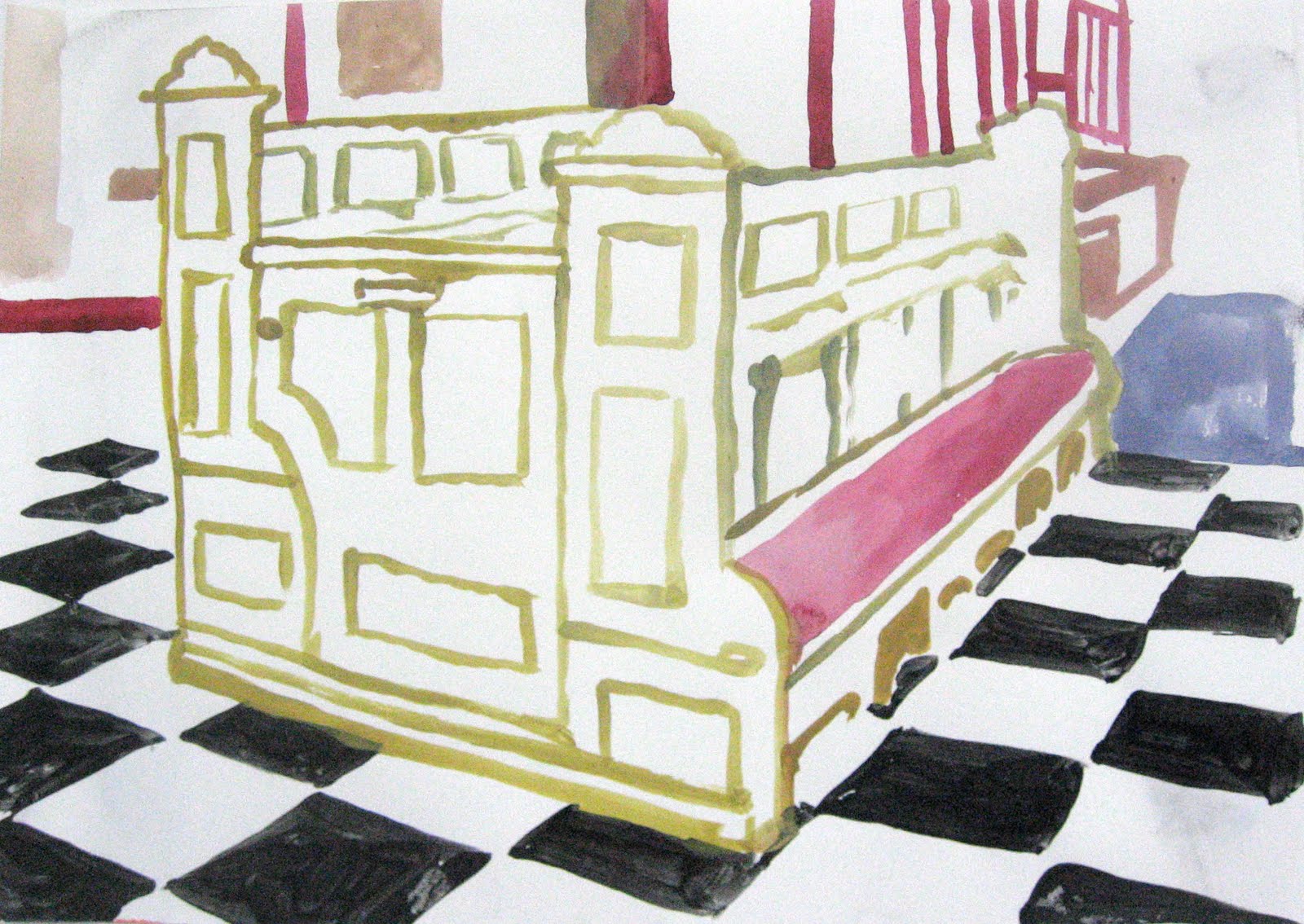
1605 Howe records the gift of Robert Peake, goldsmith, to St Seplulchre church of a communion table ‘all richly gilded over and round about, as well below as above both tressels and footpace and at every upper corner imbost with silver plate.

footpace = a raised platform
THE Priest kneels on the footpace--quite clear of the altar; the Deacon kneels on his step, below the Priest to the right of the latter, the Subdeacon to the Priest's left, on the step below that of the Deacon. The Clerk (who cannot be seen in this plate) kneels in his usual place, facing north. The Taperers stand, one on each side of the entrance to the Choir, guarding (as it were) the approach to the altar. They take up this position during the singing of the Preface (see D. C., p. 37).


Hence he reached the church without observation, and the door being only latched he entered. The hay-trusser deposited his basket by the font, went up the nave till he reached the altar-rails, and opening the gate entered the sacrarium, where he seemed to feel a sense of the strangeness for a moment; then he knelt upon the footpace. Dropping his head upon the clamped book which lay on the Communion-table, he said aloud--

"I, Michael Henchard, on this morning of the sixteenth of September, do take an oath before God here in this solemn place that I will avoid all strong liquors for the space of twenty-one years to come, being a year for every year that I have lived. And this I swear upon the book before me; and may I be strook dumb, blind, and helpless, if I break this my oath!"

'Cecil Papers: Miscellaneous 1605', Calendar of the Cecil Papers in Hatfield House, Volume 17: 1605 (1938), pp. 570-649. URL: http://www.british-history.ac.uk/report.aspx?compid=112256&strquery=peake sepulchre Date accessed: 14 March 2010. >

The alderman's deputy, common council, churchwardens and ancient inhabitants of St. Sepulchre's without Newgate, [London], to the Same. [? 1605].It has lately pleased the King to advance Dr. Androwes, Dean of Westminster, to the bishopric of Chichester, by means whereof a residencer's place in St. Paul's is now void and in his Majesty's gift. They pray that the same may be bestowed upon Dr. Spenser, vicar of the said parish, whose living is very small and insufficient to maintain his family, having charge of 20,000 souls within that great and spacious parish.—Undated. Signed: Ralphe Garfielde deputy; John Matingley, George Pedlar, James Hodgson, Olyver Easton, Ralphe Smyth, Jhon Webster, William Porter, Hennery Callaway, John Odway, Nychollas Robert, Willam Larkine, William Baigley and Thomas Cornish; Henry Bowlind, Thomas Dennis, Robart Peake and John Lowe, churchwardens. 1 p. (197. 88.)

Wednesday, 24 March 2010

the fabulous life and times of ...


Did those who sipped brandy in the William and Mary Room find themselves stirred more by the 1590 painting of Sir Thomas Crompton or by being able to stare at themselves in the superb pair of mirrors in their gilt-gesso frames… Isadore Barmash

Benjamin Sonnenberg, the press agent extraordinaire who single-handedly invented the notion of corporate image-making and in the process made a fortune. He was an Edwardian-style bon vivant and an astute art and antiques collector. His 37-room Gramercy Park house, with its paneled rooms and fine 18th-century furniture, reflected his Anglophilia, as well as a passion for brass and clocks.

Thursday, 18 March 2010

the winter queen


Elizabeth, Queen of Bohemia by Robert Peake the Elder oil on canvas, circa 1610

Elizabeth, queen of bohemia 1642, Gerrit van Honthorst

Elizabeth Stuart (1596 - 1662), known as the 'Winter Queen', was the eldest daughter of James I of England. She married Frederick, the Elector of the Palatinate, in 1613. He accepted the Bohemian crown in 1619, and was expelled from Bohemia in the following year. They lived in exile in Holland from 1621 onwards. She returned to England in 1661, and stayed in the London house of the 1st Earl Craven. In the following year she moved into Leicester House in Leicester Square where she died a few weeks later on 13 February.

The picture was painted during the Queen's exile in Holland, ten years after she had been widowed, and may have been commissioned to mark this anniversary. She is shown as a grieving widow, wearing black with very few pieces of jewellery, notably the pearl earrings which had been given to her by her husband. She holds a stem in her hand on which there are two roses, one healthy and one wilted, a symbol of her widowed state along with the black ribbon on her arm. The dog can be interpreted as a symbol of fidelity.


she corresponded with Descartes