Showing posts with label templum. Show all posts
Sunday, 26 April 2015
Thursday, 27 November 2014
avebury // stukeley
Burning the heretic
*The term "auto da fe" (or auto de fe) means "act of faith" and refers to the Spanish Inquisition's ritual of judging and condemning heretics. The ceremony has generally been thought to include executions by burning at the stake (which is no doubt what Stukeley is alluding to), though some sources claim that the actual executions were held separately.
**Herostratus sought to make a name for himself by setting fire to the Temple of Artemis in Ephesus (Turkey) in 356 BC. He boasted proudly of his act, so the authorities not only executed him but decreed that his name should never be spoken again, on penalty of death. Obviously it didn't work, and the name "Herostratus" subsquently became associated with the idea of seeking glory through acts of destruction or violence.
http://www.avebury-web.co.uk/the_shame.htmlhttp://www.avebury-web.co.uk/the_shame.html
****************************
Our Lady of Fatima
************
Claudio Colaguori in Agon Culture: Competition, Conflict and the Problem of Domination. For Colaguori, "the agon is literally the arena of competition, the scene of contest, and the locus of adversarial conflict. The philosophy of agonism affirms the idea that transcendence, truth, and growth are generated from the outcome of the contest...the concept of agonism is often understood in an affirmative sense as the generative principle of economy, society and even natural ecology and personal growth... The ambivalent character of agonism is that it is often seen as a mode of transcendence, while its instrumental relation to the mode of destruction is rarely acknowledged".
Just before I visited this place... the inhabitants were fallen into the custom of demolishing the stones, chiefly out of covetousness of the little area of ground, each stood on. First they dug great pits in the earth, and buried them. The expence of digging the grave, was more than 30 years purchase of the spot they possessed, when standing. After this, they found out the kanck of burning them, which has made most miserable havock of this famous temple. One Tom Robinson the Herostratus of Abury,* is particularly eminent for this kind of execution, and he very much glories in it. The method is, to dig a pit by the side of the stone, till it falls down, then to burn many loads of straw under it. They draw lines of water along it when heated, and then with smart strokes of a great sledge hammer, its prodigious bulk is divided into many lesser parts. But this Atto de fe** commonly costs thirty shillings in fire and labour, sometimes twice as much. They own too 'tis excessive hard work, for these stones are often 18 foot long, 13 broad, and 6 thick, that their weight crushes the stones in pieces, which they lay under them to make them lie hollow for burning, and for this purpose they raise them with timbers of 20 foot long, and more, by the help of twenty men, but often the timbers were rent to pieces.Stukeley goes on to write that a single stone could provide enough pieces to build an ordinary house, but that because of the nature of the stone, such a house "is always moist and dewy in winter, which proves damp and unwholsome, and rots the furniture. The custom of thus destroying them is so late, that I could easily trace the obit of every stone; who did it, for what purpose, and when, and by what method, what house or wall was built out of it, and the like."
*The term "auto da fe" (or auto de fe) means "act of faith" and refers to the Spanish Inquisition's ritual of judging and condemning heretics. The ceremony has generally been thought to include executions by burning at the stake (which is no doubt what Stukeley is alluding to), though some sources claim that the actual executions were held separately.
**Herostratus sought to make a name for himself by setting fire to the Temple of Artemis in Ephesus (Turkey) in 356 BC. He boasted proudly of his act, so the authorities not only executed him but decreed that his name should never be spoken again, on penalty of death. Obviously it didn't work, and the name "Herostratus" subsquently became associated with the idea of seeking glory through acts of destruction or violence.
http://www.avebury-web.co.uk/the_shame.htmlhttp://www.avebury-web.co.uk/the_shame.html
****************************
Our Lady of Fatima
The Three Secrets
The Sun Miracle
Near the entrance to the sanctuary by the rectory is a Berlin Wall Monument, containing a 5,732-pound chunk of the wall donated by a Portuguese emigrant to Germany after it fell in 1989. He offered it as a memorial of God's intervention in bringing down Communism, as promised at Fatima.10. Berlin Wall
At the entrance of the Sanctuary, on the south side of the Rectory, one may visit a monument of the Berlin Wall's, consisting of a concrete segment that was part of it. (The Walls construction started during the night between the 12th. and 13th. of August, 1961 and its demolition began the 9th. of November, 1989) This segment was offered by means of Virgilio Casimiro Ferreira, a Portuguese emigrant to Germany and is here placed as a grateful memorial of God's intervention for the fall of Communism as promised at Fatima. The segment weighs 2,600 kilos (5,732 lbs.) and measures 3.60 meters (11 ft. 9 in.) high by 1.20 meters (3 ft. in.) wide. The present monument was designed by the architect J. Carlos Loureiro and was inaugurated on the 13th. of August, 1994.************
Claudio Colaguori in Agon Culture: Competition, Conflict and the Problem of Domination. For Colaguori, "the agon is literally the arena of competition, the scene of contest, and the locus of adversarial conflict. The philosophy of agonism affirms the idea that transcendence, truth, and growth are generated from the outcome of the contest...the concept of agonism is often understood in an affirmative sense as the generative principle of economy, society and even natural ecology and personal growth... The ambivalent character of agonism is that it is often seen as a mode of transcendence, while its instrumental relation to the mode of destruction is rarely acknowledged".
Labels:
agon,
berlin,
economy,
fire,
fragment,
ideological archaeology,
spoglia,
stone,
stonehenge,
templum,
wall
Wednesday, 21 March 2012
Sunday, 13 February 2011
Thursday, 30 September 2010
these marble steps
D. O. M.
SEDENTE BENEDICTO XIII
PONT. MAX.
L U D O V I C O X V
IN GALLIIS REGNANTE
EIVSQ. APVD SANCTAM SEDEM
NEGOTIIS PRÆPOSITO
MELCHIORE S. R. ECCLESIÆ
CARDINALI DE POLIGNAC
ARCHIEPISCOPO AVSCITANO
AD SACRÆ ÆDIS ALMÆQVE VRBIS
O R N A M E N T V M
AC CIVIVM COMMODVM
MARMOREA SCALA
DIGNO TANTIS AVSPICIIS OPERE
ABSOLVTA
ANNO DOMINI MDCCXXV
Benedict XIII sitting in the papal chair as Pontifex Maximus; Louis XV reigning in France; Melchior de Polignac, Cardinal of the Holy Roman Church, and Archbishop of Aquitaine, being his minister at the sacred see; these marble steps, in a manner worthy of such auspices, for the ornamentation of the sacred temple (the church above) and the beloved city, and for the convenience of the citizens, were completed in the year of our Lord, 1725.
Friday, 23 July 2010
Terminus: boundary stone
The new work was hardly begun, when, we are told, heaven itself was moved to give a sign of the future greatness of Rome's dominion: for when the auguries were taken, the birds allowed the secularization of all the places of worship except the shrine of Terminus. the fact that of all gods Terminus alone was not moved from his place or called to leave the ground which was consecrated to his worship, was taken to portend the stability and permanence of everything Roman. Hard upon this happy augury came another strange event, which seemed to foretell the grandeur of our empire: a man's head with the features intact was discovered by workmen who were digging the foundations of the temple. This meant without a doubt that on this spot would stand the imperial citadel of the capital city of the world. Nothing could be plainer.
Livy 1.55 (Tarquinus Superbus)
Monday, 26 April 2010
Monday, 29 March 2010
churchwarden
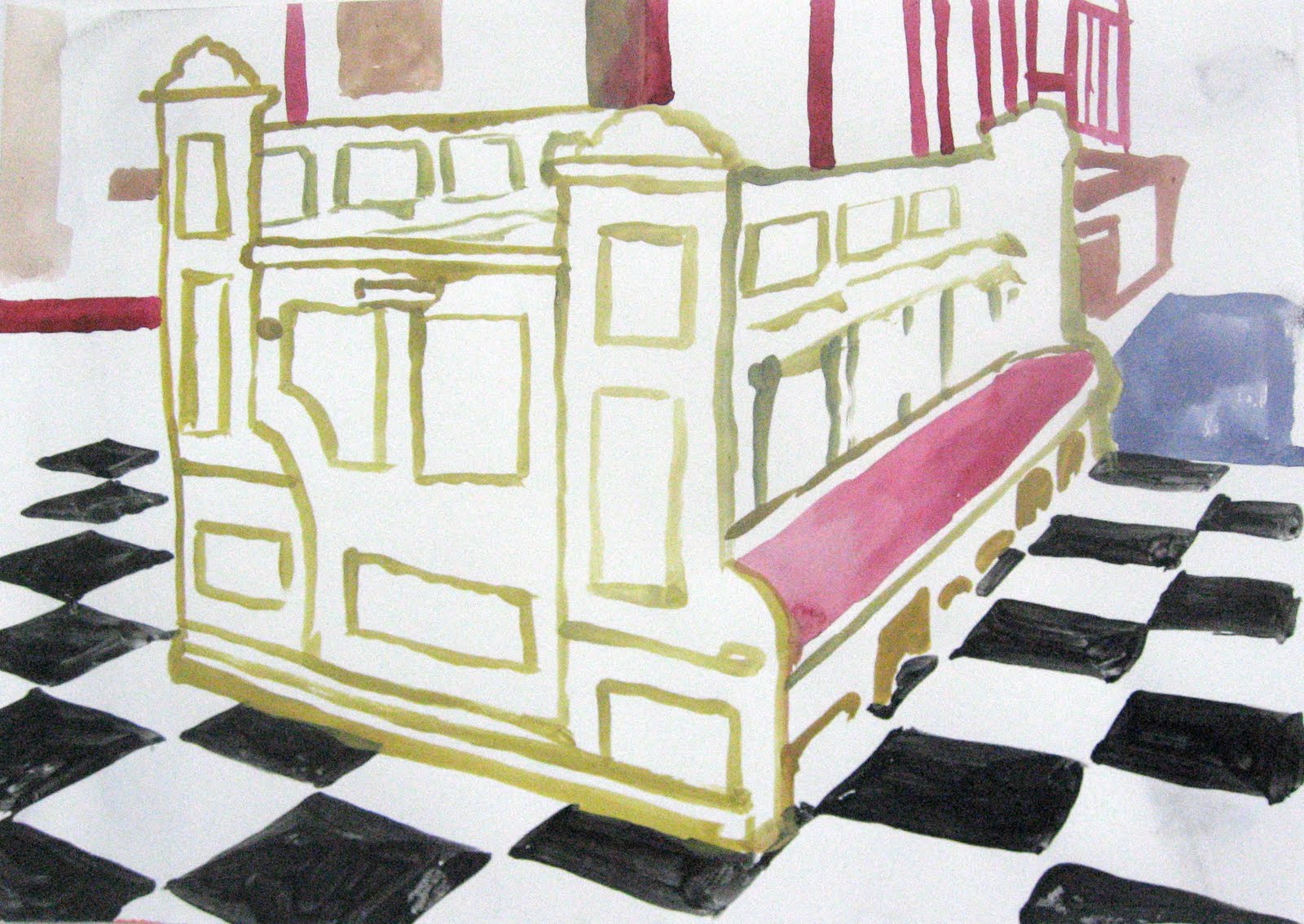
1605 Howe records the gift of Robert Peake, goldsmith, to St Seplulchre church of a communion table ‘all richly gilded over and round about, as well below as above both tressels and footpace and at every upper corner imbost with silver plate.
footpace = a raised platform
THE Priest kneels on the footpace--quite clear of the altar; the Deacon kneels on his step, below the Priest to the right of the latter, the Subdeacon to the Priest's left, on the step below that of the Deacon. The Clerk (who cannot be seen in this plate) kneels in his usual place, facing north. The Taperers stand, one on each side of the entrance to the Choir, guarding (as it were) the approach to the altar. They take up this position during the singing of the Preface (see D. C., p. 37).
Hence he reached the church without observation, and the door being only latched he entered. The hay-trusser deposited his basket by the font, went up the nave till he reached the altar-rails, and opening the gate entered the sacrarium, where he seemed to feel a sense of the strangeness for a moment; then he knelt upon the footpace. Dropping his head upon the clamped book which lay on the Communion-table, he said aloud--
"I, Michael Henchard, on this morning of the sixteenth of September, do take an oath before God here in this solemn place that I will avoid all strong liquors for the space of twenty-one years to come, being a year for every year that I have lived. And this I swear upon the book before me; and may I be strook dumb, blind, and helpless, if I break this my oath!"
'Cecil Papers: Miscellaneous 1605', Calendar of the Cecil Papers in Hatfield House, Volume 17: 1605 (1938), pp. 570-649. URL: http://www.british-history.ac.uk/report.aspx?compid=112256&strquery=peake sepulchre Date accessed: 14 March 2010. >
The alderman's deputy, common council, churchwardens and ancient inhabitants of St. Sepulchre's without Newgate, [London], to the Same. [? 1605].It has lately pleased the King to advance Dr. Androwes, Dean of Westminster, to the bishopric of Chichester, by means whereof a residencer's place in St. Paul's is now void and in his Majesty's gift. They pray that the same may be bestowed upon Dr. Spenser, vicar of the said parish, whose living is very small and insufficient to maintain his family, having charge of 20,000 souls within that great and spacious parish.—Undated. Signed: Ralphe Garfielde deputy; John Matingley, George Pedlar, James Hodgson, Olyver Easton, Ralphe Smyth, Jhon Webster, William Porter, Hennery Callaway, John Odway, Nychollas Robert, Willam Larkine, William Baigley and Thomas Cornish; Henry Bowlind, Thomas Dennis, Robart Peake and John Lowe, churchwardens. 1 p. (197. 88.)
Labels:
hardy,
london,
robert peake,
round table,
St Sepulchre,
templum,
webster
Thursday, 25 March 2010
Thursday, 29 October 2009
On Truth and Lies in an Extra-Moral Sense
Just as the Romans and Etruscans cut up the heavens with rigid mathematical lines and confined a god within each of the spaces thereby delimited, as within a templum, so every people has a similarly mathematically divided conceptual heaven above themselves and henceforth thinks that truth demands that each conceptual god be sought only within his own sphere. Here one may certainly admire man as a mighty genius of construction, who succeeds in piling an infinitely complicated dome of concepts upon an unstable foundation, and, as it were, on running water. Of course, in order to be supported by such a foundation, his construction must be like one constructed of spiders' webs: delicate enough to be carried along by the waves, strong enough not to be blown apart by every wind. As a genius of construction man raises himself far above the bee in the following way: whereas the bee builds with wax that he gathers from nature, man builds with the far more delicate conceptual material which he first has to manufacture from himself. In this he is greatly to be admired, but not on account of his drive for truth or for pure knowledge of things. When someone hides something behind a bush and looks for it again in the same place and finds it there as well, there is not much to praise in such seeking and finding. Yet this is how matters stand regarding seeking and finding "truth" within the realm of reason. If I make up the definition of a mammal, and then, after inspecting a camel, declare "look, a mammal" I have indeed brought a truth to light in this way, but it is a truth of limited value. That is to say, it is a thoroughly anthropomorphic truth which contains not a single point which would be "true in itself" or really and universally valid apart from man. At bottom, what the investigator of such truths is seeking is only the metamorphosis of the world into man. He strives to understand the world as something analogous to man, and at best he achieves by his struggles the feeling of assimilation. Similar to the way in which astrologers considered the stars to be in man 's service and connected with his happiness and sorrow, such an investigator considers the entire universe in connection with man: the entire universe as the infinitely fractured echo of one original sound-man; the entire universe as the infinitely multiplied copy of one original picture-man. His method is to treat man as the measure of all things, but in doing so he again proceeds from the error of believing that he has these things [which he intends to measure] immediately before him as mere objects. He forgets that the original perceptual metaphors are metaphors and takes them to be the things themselves.
Friedrich Nietzsche, “On Truth and Lies in an Extra-Moral Sense”
Fragment, 1873: from the Nachlass.
Compiled from translations by Walter Kaufmann and Daniel Breazeale.
Text amended in part by The Nietzsche Channel.
(downloaded from http://www.geocities.com/thenietzschechannel/tls.htm)
Subscribe to:
Posts (Atom)